Showing posts with label Classic. Show all posts

Monday, November 14, 2011

Classic Movies: Full Metal Jacket (1987)


By Jason Haskins

There are many great American War films, but there's one that stands head and shoulders above all the rest: Stanley Kubrick's Full Metal Jacket.

Saturday, October 8, 2011

Classic Movies: Unforgiven (1992)


By Jason Haskins

I'm never going to forgive Clint Eastwood for this damn movie. Eastwood might have been reaching the peak of his directorial pursuits (this, of course, being pre-Million Dollar Baby era) and some thought he was going to slow down as an actor, which he had hinted towards around the time that Unforgiven came out in 1992, but Eastwood created his finest masterpiece. One that literally closed the book on the Western genre. Sure, there have been some good Westerns since including HBO's series, Deadwood, but none have come close he sheer significance of Unforgiven's drive to push new boundaries for the genre as well as undercut all of the clichés and make something so powerful.

Monday, August 22, 2011

Classic Movies: The Godfather (1972)


By Jason Haskins

There are a lot of great examples of classic American cinema, but the one gem that comes to mind immediately is Francis Ford Coppola's 1972 classic, The Godfather, which changed the entire genre of gangster film. Growing up, my biggest exposure to gangster films were Martin Scorsese's crasser brand of criminals and characters and I seem to think there are two sides--those who dig Goodfellas and those who enjoy The Godfather. I have to find a middle ground, because both films are tremendous efforts. If you've never seen this you are in dire need of catch up.

Saturday, August 13, 2011

Martial Arts Madness: Enter the Dragon (1973)


By Jason Haskins

Bruce Lee was the late great martial arts expert/philosopher who was one of the first Asian American actors to hit it big onscreen and introduced a culture to smarter kung fu flicks. While he only made a handful of pictures in his lifetime, these stand up as some of the best the genre has to offer. Enter the Dragon was the last completed picture he starred in and was released a little bit after his death in 1973 of cerebral edema. While the last movie he worked on was The Game of Death, I find the film (though great) much unfinished and certainly not a high note of this caliber to end his career on.

Monday, August 8, 2011

Classic Movies: It Happened One Night (1934)


By Jason Haskins

Frank Capra released one of his best pictures in 1934 during an awkward time in society, when the newly found MPAA was really cracking down on what could and couldn't be shown in movies. This censorship could have been a very damning thing to the entertainment industry, and it certainly was for a ton of movies, but true geniuses came forward and used their creativity to write around the rules and make movies even more tongue-in-cheek and sexier than if outward stuff was actually shown. One of the prime examples of this loophole being used is It Happened One Night starring Clark Gable and Claudette Colbert. Let the walls of Jericho fall!

Wednesday, August 3, 2011

What's it Meta For? : 8 1/2 (1963)


By Tom Swift


This is the first installment in a group of reviews I’m doing on the use of meta in film. Meta, vaguely put, is when a concept is abstracted from another concept which is then used to inform or complete the latter; some well known examples are A Midsummer’s Night Dream’s or Hamlet’s play within a play, Italo Calvino’s hypernovel If on a winter’s night a traveler(1979) - a novel imbedded with 10 false novels - or Roland Barthe’s Criticism and Truth (1970), a critique on traditional literary critique in France. Film achieves this most frequently by producing films about producing films or making a film about the failure of its own production, each using the film inside the film to establish a more oppositional realism, but each to their own respective ends. I will be exploring their ends, one by one and attempting to find out how deep each goes.


Sunday, July 31, 2011

Classic Movies: Singin' in the Rain (1952)


By Jason Haskins


I'm picky about musicals. Don't get me wrong, I love them, but I'm awfully reserved. Some completely throw me off guard with their creativity like 1981's Pennies from Heaven. Others make me want to rip my eyes and ears out (...Grease...admit it, Grease sucks). Then there were the ones I grew up on like The Wizard of Oz--which isn't just one of my all-time favorite movies, but one of my favorite musicals as well (if you'd classify it as such). However, when I think of the Hollywood musical and one full of dance numbers and pleasant story, only one film comes to mind: Singin' in the Rain. This is the perfect musical with one of the best stories the genre has to offer.

Monday, July 25, 2011

Classic Movies: Umberto D. (1952)


By Jason Haskins

Why do you do this to us, Vittorio De Sica?! My first viewing of one of his films was the superb Bicycle Thieves (1948), which blew me away in all regards of the term--displaying a neo-realist perception of post-war Italy. Well, look what he does again. I finally got the courage to watch Umberto D. (1952), which is arguably his second most famous film, which has made the biggest impact on cinema, and I think I've struck gold twice. This is another great piece of work that this man did--and available, of course, on the Criterion Collection.

Saturday, June 25, 2011

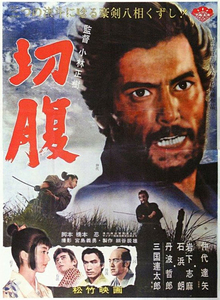
Classic Movies: Harakiri (1962)


By Paco McCullough

Masaki Kobayashi’s (Kwaidan, The Human Condition) Harakiri (1962) is one of the best films I have seen in a long time. In May of 1630, Japan has been at peace for nearly twenty years. For the samurai class that have made warfare their livelihood, this is a disaster. Many houses of samurai have collapsed and the streets are now flooded with ronin, masterless samurai. Desperate ronin have been going from feudal estate to feudal estate, asking to perform harakiri--suicide by disembowelment. The film begins with a ronin (Tatsuya Nakadai) making this request. To elaborate on the plot would detract from your enjoyment of the film, as one of the film’s greatest strength is its unexpected twists.
    Harakiri uses feudal Japan as a backdrop to tell a story about power, honor, and desperation. It skillfully discusses the inability of the successful to empathize with the less fortunate while also entertaining. Though it is a samurai film, there are no action scenes until almost two hours into the film. This film is frequently compared to some of Kurosawa’s work. If so, I would compare this more to Ikiru then Seven Samurai or Yojimbo. Because of this, we get to know the characters and care about them. Just don’t expect a action-filled adventure.
    Every single element of this film was incredibly well done. Tatsuya Nakadai and Akira Ishihama give incredible performances. One of Ishihama’s scenes was devastating to watch and will probably stick with most viewers for years to come. Beyond this, the cinematography is consistently beautiful. The score is also quite incredible. It’s minimalism only heightens its unsettling qualities.
    I cannot praise this film highly enough. It is unquestionably a masterpiece and deserves multiple viewings. Get off your computer and go watch it.

5 out of 5

(c) Tanner McCullough, 2011